A Logical Takedown of OpenAI's Proposals for the US AI Action Plan
Or: "A not-so-brief list of the unsurmountable pile of logical fallacies used in the arguments in favour of fair use for AI training"
TL;DR. April 2025 Opinion: there are no valid arguments for not compensating the owners of copyrighted content when training an AI. All central arguments are reviewed and found to have fallacious reasoning. I categorize the OpenAI submissions as MANIPULATION IN ACTION.
The only remaining argument is: we won't pay if we can get away with it... it's just better for our bottom line...
Context
Big Tech, Google, Anthropic, OpenAI... are lobbying for the upheaval of copyright law in order to train AI on copyrighted content without compensating the copyright owners.
The main argument is this:
We need a new copyright strategy (fair use: not paying) for AI training because AI is like humans, we don't really know how we learn nor how we create and AI is the same. We need this fast because of China... safety safety safety (they don't pay so why should we?)
General arguments used:
Document 1: "AI in America: OpenAI's Economic Blueprint February 2025 Update"
- Page 13–14 — Under "Infrastructure as Destiny":
- "assuring AI developers that AI models will have the ability to learn from publicly available information"
- "other actors, including developers in other countries, make no effort to respect or engage with the owners of IP rights. If the US and like-minded nations don't address this imbalance through sensible measures that help advance AI for the long-term, the same content will still be used for AI training elsewhere, but for the benefit of other economies."
- Page 14 — Under "Solutions":
- "Ensuring that AI has the ability to learn from universal, publicly available information, just like humans do, while also protecting creators from unauthorized digital replicas."
Document 2: "Letter from Christopher Lehane to Faisal D'Souza, March 13, 2025"
- Page 4 — Under "What we propose":
- "A copyright strategy that promotes the freedom to learn: [...] The federal government can both secure Americans' freedom to learn from AI, and avoid forfeiting our AI lead to the PRC by preserving American AI models' ability to learn from copyrighted material."
- Page 10–11 — Under "3. Copyright: Promoting the Freedom to Learn":
- "American copyright law, including the longstanding fair use doctrine, protects the transformative uses of existing works, ensuring that innovators have a balanced and predictable framework for experimentation and entrepreneurship."
- "OpenAI's models are trained to not replicate works for consumption by the public. Instead, they learn from the works and extract patterns, linguistic structures, and contextual insights."
- "America has so many AI startups, attracts so much investment, and has made so many research breakthroughs largely because the fair use doctrine promotes AI development."
- Contrasts with EU and UK approaches that create "the same regulatory barriers to AI development"
- "Applying the fair use doctrine to AI is not only a matter of American competitiveness — it's a matter of national security."
- "If the PRC's developers have unfettered access to data and American companies are left without fair use access, the race for AI is effectively over."
- Page 11 — Proposals regarding copyright:
- "Shaping international policy discussions around copyright and AI, and working to prevent less innovative countries from imposing their legal regimes on American AI firms and slowing our rate of progress."
- "Monitoring domestic policy debates and ongoing litigation, and weighing in where fundamental, pro-innovation principles are at risk."
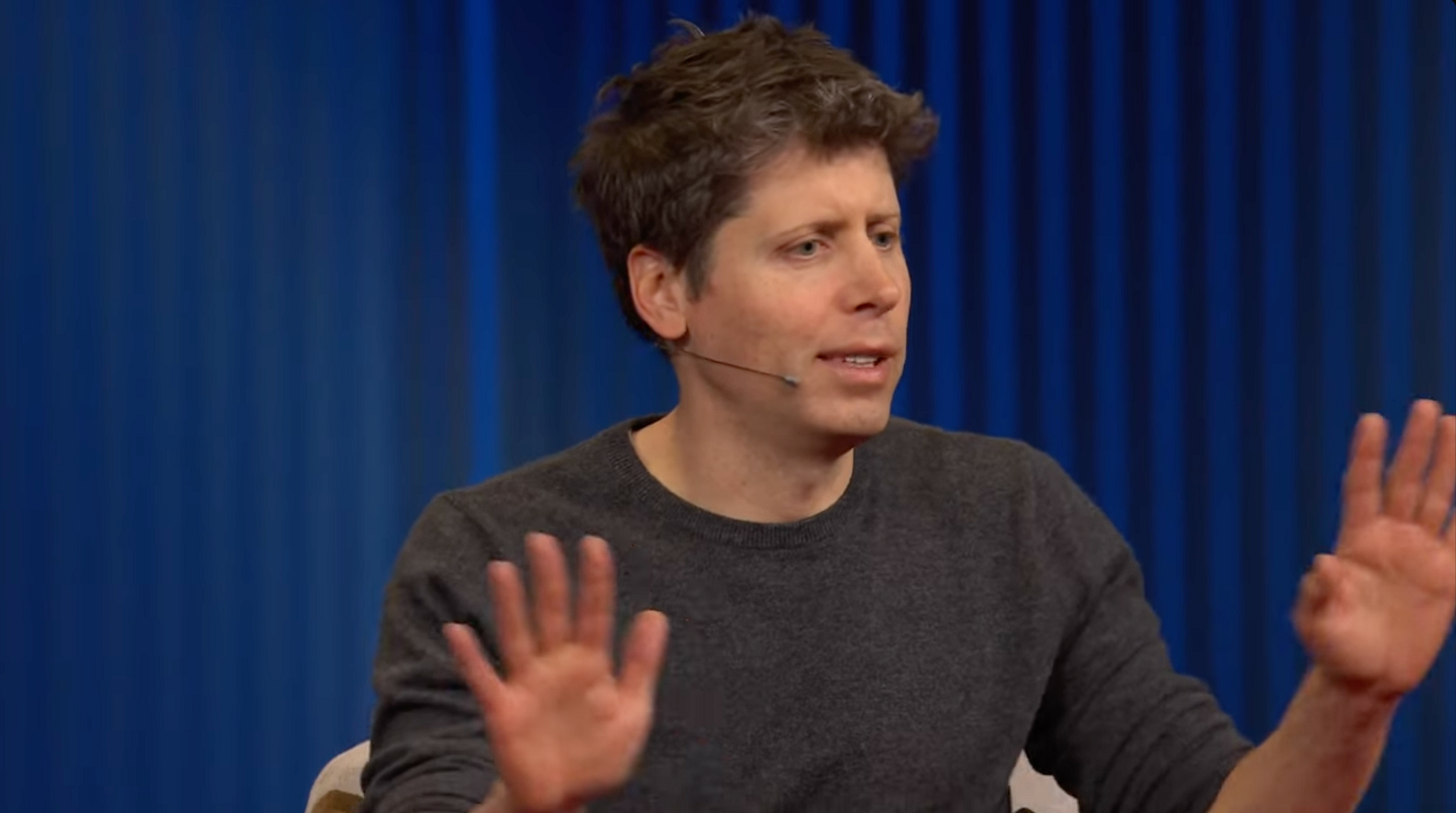
Sam Altman at TED (April 2025),
when asked about IP theft as a model generates Charlie Brown cartoons, stated:
- "There's really no way to know if it is thinking that or it just saw that a lot of times in the training set" — Admission to the use of Charlie Brown cartoons in the training set.
- "People have been building on the creativity of others for a long time, people take inspiration for a long time, but as the access to creativity gets incredibly democratized..." — False Equivalence.
- "If you're a musician and you spend your whole life [...] listening to music and then you get an idea and you go compose a song that is inspired by what you've heard before but a new direction. It'd be very hard for you to say 'This much was from this song I heard when I was 11'" — False Analogy.
Logical Fallacies in OpenAI's Copyright Arguments
1. False Equivalence
Freedom is not the same as Free, Publicly Available is not the same as Public Domain
Equating AI learning from copyrighted works with human learning:
"Ensuring that AI has the ability to learn from universal, publicly available information, just like humans do, while also protecting creators from unauthorized digital replicas."
- Human learning is not free: humans mostly access content legally through purchases, subscriptions, or licensed channels... even radio or public libraries compensate creators.
- AI uses millions of copyrighted works in their entirety, requiring unauthorized digital replicas of original works.
- Publicly available (ex: piracy) is not the same as public domain. Even content that is "accessible to view" is not necessarily "free to use commercially."
- AI is trained to reproduce elements almost identical to the training set, with far greater fidelity than most humans could. These are blocked on output/inference, not in training.
- Contradiction/Doublespeak: They claim to protect "creators from unauthorized digital replicas" while simultaneously advocating for unauthorized use of those exact same works during training. They can't protect against unauthorized replicas while lobbying to legalize the use of unauthorized replicas.
How a model technically learns and its similarity or dissimilarity to human learning is an irrelevant argument: The main difference is that AI models are trained on unlicensed content with no compensation whereas most content channels accessed by humans when learning compensate the creators.
2. False Analogy
Also: "If you're a musician and you spend your whole life [...] listening to music and then you get an idea and you go compose a song that is inspired by what you've heard before but a new direction. It'd be very hard for you to say 'This much was from this song I heard when I was 11'"
- This is intentionally misleading and manipulative. It may apply to humans but with an AI the maker of a model knows exactly what training content went into the model and exactly how it was designed to imitate that content.
- Not only that: It is possible to determine mathematically and to a very high degree how a model generates and from which sources it has learned which patterns. The fact that it is not 100% deterministic or precise does not mean it is not possible to do like with humans.
Appeal to Ignorance: Assumes AI's influences can't be traced because human influences are hard to pinpoint, ignoring AI's traceable model activations and attention patterns.
Suppressed Evidence: Omitting the technical reality that AI models can be analyzed to determine which training examples most strongly influenced a particular output. This is a measurable, quantifiable process unlike human memory and inspiration.
Category Error: Conflating human cognition (subjective, complex) with AI processes (deterministic, mathematical and analyzable), despite their fundamental differences.
Begging the Question: Assumes AI creativity mirrors human creativity in how influences are drawn, which is the debated issue.
Misleading Vividness: Uses emotive human musician imagery to create an emotionally appealing but technically inaccurate depiction of AI's technical functioning.
Model attribution can be determined mathematically and with high precision, identifying which training sources influenced specific outputs. While this has some statistical uncertainties, they are quantifiable and traceable which is not comparable to human inspiration. The technical capacity to map influences in AI systems is a huge difference from human creativity (currently). Altman knows he is making this scientifically unsound comparison.
3. Equivocation Fallacy (Ambiguity)
Using misleading language around "publicly available information":
- Blurring the distinction between "publicly available" and "public domain", content being accessible doesn't make it free to use commercially
- Conflating "publicly available" with "legally usable without compensation", publicly available in this case is mostly through piracy, for example with music.
There are different asset types, text, image, video, audio, etc.. access to it on the internet or on piracy sites does not make it free to use in a legal sense, if it did they would be happy to disclose the training data.
4. Appeal to Fear
Throughout the documents, there is a heavy reliance on national security concerns:
- "If the PRC's developers have unfettered access to data and American companies are left without fair use access, the race for AI is effectively over."
- Presenting a false choice: either allow unrestricted use of copyrighted material or lose to China
- Diverting attention from the legitimate copyright concerns to national security fears.
Being able to train models on Studio Ghibli or Warner Music content without paying for it does not increase or decrease national security risks, it only affects the bottom-line profit of the AI company.
5. False Dilemma
Presenting only two options:
- Either unrestricted FREE AI training on copyrighted materials or American tech falling behind in the AI "security" race.
- Ignoring several solutions like licensing frameworks, compensation systems, or opt-in approaches
You can still opt to pay for content and beat China.
6. Inconsistent Premises
Contradictory positions:
- Claiming to protect "the rights and interests of content creators" while advocating for using their work without compensating them.
- Arguing for "common-sense rules of the road that safeguard the public" while proposing rules that potentially directly damage creators.
Simply Hypocrisy.
7. Misleading Historical Analogy
Comparing UK's Red Flag Act for cars last century:
- Creating a very false parallel between safety regulations for early automobiles and copyright protections as a way to argue for not paying for copyrighted content.
8. Slippery Slope Fallacy
The documents suggest that without allowing AI companies to use copyrighted material for free:
- America will lose the AI race to China
- Democratic values will be undermined
They are not establishing the necessary causal connection between these outcomes... just pay something for it, problem solved.
9. Appeal to Hypocrisy (Tu Quoque)
The argument that the PRC won't respect copyright, so OpenAI shouldn't be constrained by it:
- "The PRC is unlikely to respect the IP regimes of any of such nations for the training of its AI systems"
Using others' alleged bad behavior to justify their own proposed approach.
10. Bait and Switch Fallacy
Shifting between defensible and controversial positions:
- Reasonable position: Support American innovation and security
- Controversial position: Use copyrighted material without compensation
Defending the controversial position by retreating to the reasonable position when challenged.
11. Straw Man Argument
Characterize copyright protections as:
- Simply "rigid copyright rules" that "repress innovation"
Ignores the actual purpose and nuance of copyright law in promoting creation by ensuring the compensation and livelihood of the creators.
12. Special Pleading
Argues for exceptional special treatment under copyright law:
- "We're trained to not replicate works for consumption by the public"
This is distracting from the fact that the training itself requires massive consumption of unlicensed works which is intended to be able to output almost exact replicas but blocked when used.
13. Begging the Question (Circular Reasoning)
Assuming what they are trying to prove:
- Arguing that AI training on copyrighted content is fair use because it's transformative but whether it truly is "transformative" under fair use is precisely what is in question.
14. Red Herring
Emphasis on competition with China to divert attention from the core copyright issue:
- "Given concerted state support for critical industries and infrastructure projects, there's little doubt that the PRC's AI developers will enjoy unfettered access to data"
- Shifting the focus from the legitimate copyright debate to geopolitical competition
Paying or not for content has absolutely nothing to do with national security, it is a matter of profit and corporate greed, why pay if you can get away without doing it?
15. Inconsistency Regarding Intellectual Property
Inconsistent stance on IP protection:
- Vigorously defending their own AI technology and business model IP
- While simultaneously arguing against respecting others' IP in content creation
- They warn about the PRC's view that "violations of American IP rights [are] a feature, not a flaw" while advocating for a position that some could characterize similarly
So then wouldn't hacking OpenAI and taking all models also be Fair Use?
16. Appealing to Novelty, the wrong novelty.
The argument relies on the idea that new technology deserves new rules:
- "AI is not social media — it's an infrastructure technology that is leading us into what our CEO Sam Altman has called the Intelligence Age"
- Suggesting that because the technology is new, traditional IP rules shouldn't apply, and ignoring that copyright law has adapted to new technologies for centuries while maintaining core principles.
What needs to happen is the adoption of novel AI attribution technologies which are currently abundant in the market, see for example my own: Musical AI
17. Burden of Proof Fallacy
Shifting the burden of proof:
- Suggesting that those who want to protect their copyrighted works must prove this won't harm AI progress
AI companies advocating for this should demonstrate with evidence why they should be exempt from copyright law.
18. False Causality
Implying a causal relationship without evidence:
- "America has so many AI startups, attracts so much investment, and has made so many research breakthroughs largely because the fair use doctrine promotes AI development"
Attributing American AI success primarily to copyright approaches without considering other factors.
19. Inappropriate Appeal to Authority
The invocation of "democratic values" creates a false authority:
- Positioning commercial interests as aligned with "democratic values" creating a false impression that opposing OpenAI's copyright position is opposing or hindering democracy.
20. Conflation of Public Interest and Commercial Interest
OpenAI's commercial interests equated as national interests:
- Corporate benefit and profit presented as identical to public and national benefit
- Distracting from the active conflict between OpenAI's profit motivation and societal and creators' interests.
"If the PRC's developers have unfettered access to data and American companies are left without fair use access, the race for AI is effectively over. America loses, as does the success of democratic AI."
For a company with 12 billion in revenue, paying for content is not fettered access.
21. Contradiction in Terms
"OpenAI's models are trained to not replicate works for consumption by the public"
No, they are blocked from replicating when used.
- The fundamental goal of training models is precisely to have them accurately predict (and thus replicate) the training data during the training phase. The loss function explicitly rewards the model for accurately reproducing its training material.
- Equivocation: Cleverly using the phrase "trained to not replicate works for consumption by the public" to create confusion between training objectives and inference-time constraints. During training, the model is absolutely trained to replicate works with high fidelity. The non-replication constraints are added separately at inference time through filtering, fine-tuning, or other post-training measures.
- Technical Misrepresentation: Models like GPT are specifically trained using next-token prediction, where success is measured by how accurately they can reproduce the exact text they were trained on. The addition of randomness (temperature, sampling techniques) during inference is separate from the training objective.
- Misleading Precision: The qualifier "for consumption by the public" attempts to distract from the fact that the training process itself involves complete replication of works. The statement conflates deployment safeguards with training methodology.
I will stop here...